|
  WELCOME to Martins Bank
Archive, and to MARTINS
BANK MAGAZINE -
our news feature in honour of the Bank’s staff publication, which from 1946
to 1969 brought news of changing times, new Branches and services and even
new technologies to those working in branches and departments in England
Wales, the Channel Islands and the Isle of Man. WELCOME to Martins Bank
Archive, and to MARTINS
BANK MAGAZINE -
our news feature in honour of the Bank’s staff publication, which from 1946
to 1969 brought news of changing times, new Branches and services and even
new technologies to those working in branches and departments in England
Wales, the Channel Islands and the Isle of Man.

From Drive-In Branches to
computers and the Cash Dispenser, it seems that Martins Bank has it all,
yet on 1 November 1968, it becomes just one more of the Barclays Group of
Companies.
This status is maintained
only until close of Business on Friday 12 December 1969, as from the
following Monday, 730 branches of the bank will open their doors under the
name of Barclays. As of 1 September
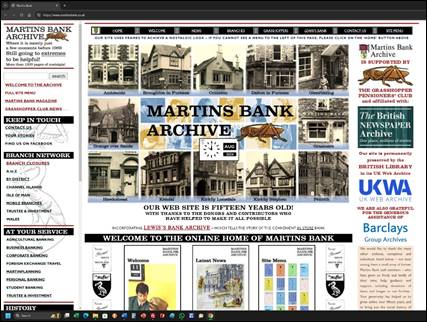
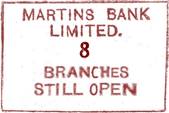
2026, Barclays has just over 200 branches still open, of which SIX are
former Martins Branches….

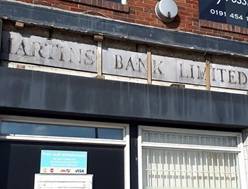
Cover Photo
  Our cover
photograph for September 2026 is new to the archive, having been supplied
to us by John Christian, grandson of Mr E D S Botting (pictured left) who
worked at the branch shown in the image 16
WHITEHALL (London Cocks
Biddulph Branch) for forty-four years – his entire career with Martins Bank!
This is an example of a good
exchange of information – John contacted us to find out more about his
grandfather’s career, and he was able to supply the Archive with a number
of photographs and other items/details that helped us to “fill in the gaps”. As a result, we now have more of story to
tell about our Branch at 16 Whitehall, and about Mr Botting. We always welcome enquiries from anyone
who would like to know about the career of a friend or relative who worked
for the Bank, and thanks to the burgeoning membership of the Grasshopper
Pensioners’ Club, we regularly receive such requests from former
staff. Our partnership with the
British Newspaper Archive is in its thirteenth year, and we have unearthed
literally thousands of lines of career details of Martins Bank Staff. This now includes details of post-merger
career moves and achievements within Barclays for a growing number of
Martins colleagues. Our cover
photograph for September 2026 is new to the archive, having been supplied
to us by John Christian, grandson of Mr E D S Botting (pictured left) who
worked at the branch shown in the image 16
WHITEHALL (London Cocks
Biddulph Branch) for forty-four years – his entire career with Martins Bank!
This is an example of a good
exchange of information – John contacted us to find out more about his
grandfather’s career, and he was able to supply the Archive with a number
of photographs and other items/details that helped us to “fill in the gaps”. As a result, we now have more of story to
tell about our Branch at 16 Whitehall, and about Mr Botting. We always welcome enquiries from anyone
who would like to know about the career of a friend or relative who worked
for the Bank, and thanks to the burgeoning membership of the Grasshopper
Pensioners’ Club, we regularly receive such requests from former
staff. Our partnership with the
British Newspaper Archive is in its thirteenth year, and we have unearthed
literally thousands of lines of career details of Martins Bank Staff. This now includes details of post-merger
career moves and achievements within Barclays for a growing number of
Martins colleagues.

Treasure Trove
  You never
know what might be lurking in your collection of old photographs and
transparencies at the bottom of that drawer you never look in anymore! We would urge you to look and see if one
of Martins Bank’s Branches might be lurking in the background somewhere! We
were delighted to acquire this superb image from 1967, which vividly brings
to life a Lincolnshire tradition of crowning such carnival queens that
dates back to 1950. In this wonderful colour image we
witness the triumphant ride through the town of SPALDING
of
the very first DEPUTY Miss Tulipland – Mrs Vivienne Bowman – on a float
that is completely carpeted with fresh tulips. You never
know what might be lurking in your collection of old photographs and
transparencies at the bottom of that drawer you never look in anymore! We would urge you to look and see if one
of Martins Bank’s Branches might be lurking in the background somewhere! We
were delighted to acquire this superb image from 1967, which vividly brings
to life a Lincolnshire tradition of crowning such carnival queens that
dates back to 1950. In this wonderful colour image we
witness the triumphant ride through the town of SPALDING
of
the very first DEPUTY Miss Tulipland – Mrs Vivienne Bowman – on a float
that is completely carpeted with fresh tulips.
Amongst many
categories covering the social history of that part of Lincolnshire known
as South Holland, our friends at https://www.heritagesouthholland.co.uk
have created a fabulous look back at the flower parades down the years,
with news cuttings and photographs of the flowers, crowds and those lucky
enough to have been crowned Miss Tulipland.
Social History that engages the minds of those who were there to
witness it, and who will then pass on the memories to their children and
grandchildren is right up our street, and in the case of Miss Tulipland’s
Deputy from 1967 being seen passing by our SPALDING
branch,
we are delighted to see history in action. There is a larger clearer
version of the transparency on our SPALDING
page,
and who knows, you might recognise yourself or a member of your family in
the crowd who appear to watching Miss Deputy Tulipland’s every move!
Banking and your Job –
“I’m in the entertainment business”
 We were contacted recently
by John Forster Young, known as Ian, who asked for details of his career
with Martins Bank. This spanned only
three years – 1960 to 1963, but there is a unique reason for this. In the words of the Martins Advertisement
you see here from the late 1950s, Ian swapped life in the bank for the
Entertainment Business. Despite the
doubts of management, he made a wonderful success of it, as he explains
here in his own words, which also include memories of the branches at which
he worked, and the staff with whom he worked… We were contacted recently
by John Forster Young, known as Ian, who asked for details of his career
with Martins Bank. This spanned only
three years – 1960 to 1963, but there is a unique reason for this. In the words of the Martins Advertisement
you see here from the late 1950s, Ian swapped life in the bank for the
Entertainment Business. Despite the
doubts of management, he made a wonderful success of it, as he explains
here in his own words, which also include memories of the branches at which
he worked, and the staff with whom he worked…
Thank
so much for sending my details from Martins Bank database , it brought back
so many happy memories of my short time at the bank, although I cannot
credit it was more than 65 years ago.
It
seems just like yesterday that I started working at Tyne Dock branch under
Manager Jim Shotton, he was nearing retirement and I remember he bought his
first car , a Hillman Minx. He was not a confident driver so he asked me to
pick the new car up with him and I drove the car to his home.
I
worked with Brenda Poulter, Valerie Redpath, Anne Stone, Sam Cross, there
was another chap a bit older than us Donald Anderson who used to go
drinking during his lunch break and come back worse for wear. I believe he
was asked to tender his resignation as one day he never came back to work.
I
really enjoyed my time during this period the banter between the young lads
and girls would never be allowed these days but just harmless good fun.
I was transferred to Laygate, South Shields, I did
not enjoy my time there, working under the manager, he was a very heavy
smoker always had a cig hanging out of his mouth and a terrible smokers
cough. The Pro manager was a Mr. Nelson also a younger man Ken Arthur were
at Laygate during my time.
|
I was then transferred to Monkwearmouth, Sunderland
branch working under Mr. Harry Smurthwaite along with another young lad
John Bruce. During my time here I worked at the sub branches at Southwick
and Fulwell. We used to use public transport to get to these sub branches
often carrying up to £15k or more back to the main office. Everyday some
wag would say, “I will carry your bag son”, fancy doing that today. I had
a guard about 65 years old, Robert Wilkinson who I believe was later
Mayor of Sunderland he kept me amused with his stories of working down
the pit.
(Right, Robert
Wilkinson, Bank Guard AND Mayor of Sunderland)
|

|
I
had a much better car than my Manager at the time and I remember being
asked by Mr Smurthwaite how I could afford a Jaguar on my £13 per week. I
had to tell him I had been working every night I could in a Night club
earning extra cash. He told me the Bank would not like this and I better
make a decision the Bank or the Night Clubs. To the absolute horror of my
parents I went to the night clubs. However things did work out for me in
1984 I was a director and 50% shareholder of the night club company when it
was sold to a Public Company . I went to live in the Isle of Man to avoid
40% Capital Gains tax.
So
many memories thank you for jogging my memory!
… it was our pleasure
Ian! Ian would like to get in touch
with anyone who remembers him, (and his jaguar?), and more details will be
in the next edition of the Grasshopper Newsletter for North Eastern
District club members who would like to contact him. Ian has also helped the Archive by
remembering (above) the forenames of many of the people he worked
with. These details will help the current
drive to populate our staff database with as many forenames as we can.
More Treasure Trove…

Image © Martins Bank
Archive Collections
In addition
to the acquisitions mentioned below, March 2026 saw a set of personal
photographs for sale on an internet auction site that turned out to have
belonged to Martins Bank’s former Ainsdale Manager Raymond F Creer. Ray Creer’s brainchild was “Finance for
Farmers and Growers” the annual booklet published by Martins, and later
Barclays, from 1955 until 1990. His wife Beryl was the first woman to
receive a managerial appointment in the Bank, and the photographs include
several pictures of Beryl at work, and of various sporting events which
both Raymond and Beryl either supported or took part in. There is also this
wonderful image of a production by Martins Bank Operatic Society from the
late 1940s. We are delighted that
this small but important collection of moments from the lives of two
members of staff are now safely held in the Archive. We also hold
significant photographs and papers from the careers of both, which has
enabled us to record their progress through the Bank from when they joined
as new entrants…
 Although January
2026 seemed endless with various storms and World events, we are now on the
brink of the rest of the year flying by as it always does! Recent finds
have brought valuable information and items to the Archive – we were
delighted to be contacted by Jeremy O’Keeffe, whose father was staff
architect at Reed and Sons Paper Mills, Aylesford Kent, at the time when
the Bank opened a sub branch there for the use of the staff of Reed, and
those of their associated companies.
An image of this little branch has long been sought, and finally it
has surfaced thanks to Jeremy’s father having one in his personal papers.
Another piece of the branch photographs jigsaw has been filled, and we look
forward to the next piece, whenever it chooses to show itself! Although January
2026 seemed endless with various storms and World events, we are now on the
brink of the rest of the year flying by as it always does! Recent finds
have brought valuable information and items to the Archive – we were
delighted to be contacted by Jeremy O’Keeffe, whose father was staff
architect at Reed and Sons Paper Mills, Aylesford Kent, at the time when
the Bank opened a sub branch there for the use of the staff of Reed, and
those of their associated companies.
An image of this little branch has long been sought, and finally it
has surfaced thanks to Jeremy’s father having one in his personal papers.
Another piece of the branch photographs jigsaw has been filled, and we look
forward to the next piece, whenever it chooses to show itself!
 Another
amazing find came in the form of a set of letters and papers which was
being auctioned on eBay. Recognising the importance of these items to the
Archive, the Grasshopper Pensioners Club have kindly secured and donated
them to us, and as befits a find of its size, plenty of scanning and
recording of information is currently taking place! It concerns the Jopling
Family – Mr William Ewart Jopling was made Staff Manager of the Bank of
Liverpool and Martins in 1926, and there are several items relating to his
career, pension and even his will, that help to enrich the information
already held for him in our Staff Database. When he retired early on ground
of ill-health in 1941, the Bank awarded him a pension equivalent to almost £90,000
in today’s money. Another
amazing find came in the form of a set of letters and papers which was
being auctioned on eBay. Recognising the importance of these items to the
Archive, the Grasshopper Pensioners Club have kindly secured and donated
them to us, and as befits a find of its size, plenty of scanning and
recording of information is currently taking place! It concerns the Jopling
Family – Mr William Ewart Jopling was made Staff Manager of the Bank of
Liverpool and Martins in 1926, and there are several items relating to his
career, pension and even his will, that help to enrich the information
already held for him in our Staff Database. When he retired early on ground
of ill-health in 1941, the Bank awarded him a pension equivalent to almost £90,000
in today’s money.
There is a
similar collection of documents relating to his son Austen Strang Jopling
(pictured, right), many of which relate to his promotion to the managership
of a number of branches. There is also one very special document which
shows that in the Second World War, he undertook a number of “special
duties” that granted him access to public offices and departments that were
off limits to the general public.
More on this particular story as soon as we can uncover the
details! So with two really big
finds in January, another in March, and the fabulous colour image of SPALDING
Branch
in 1967 (See also top of this page) 2026 has so far proved to bear great treasure,
and we look forward to seeing what else we, and our ever supportive and
vigilant visitors might find…
A question of re-numbering in Southport!
 We are
always amazed by the lengths our visitors go to, in order to help us tell
the story of the bank, and in particular of its branches and the staff who
worked in them. The bumper crop of
“findings” for January 2026 included detective work worthy of Sherlock
Holmes himself, from Jeremy Sleightholm who lives in Southport, and was
intrigued by a puzzle we had placed at the bottom of our page for the main
Southport Branch – 365 Lord Street.
An image showing a branch of the Bank in Lord Street appears on that
page, and is shown here on the RIGHT, but did
not seem to fit in with the numbering of the street. In the absence of further research, we
referred to this as one of the “mysteries from the mists of time”, still to
be uncovered. Jeremy has delved into
local records, and found the following solution to our mystery: We are
always amazed by the lengths our visitors go to, in order to help us tell
the story of the bank, and in particular of its branches and the staff who
worked in them. The bumper crop of
“findings” for January 2026 included detective work worthy of Sherlock
Holmes himself, from Jeremy Sleightholm who lives in Southport, and was
intrigued by a puzzle we had placed at the bottom of our page for the main
Southport Branch – 365 Lord Street.
An image showing a branch of the Bank in Lord Street appears on that
page, and is shown here on the RIGHT, but did
not seem to fit in with the numbering of the street. In the absence of further research, we
referred to this as one of the “mysteries from the mists of time”, still to
be uncovered. Jeremy has delved into
local records, and found the following solution to our mystery:
 I
live in Southport and I have walked past the former Southport branch many
times. Yesterday I took this photo of the building. I have read your
website's history of this branch with great interest and I am intrigued by
"the mists (and the mysteries) of time...". I
live in Southport and I have walked past the former Southport branch many
times. Yesterday I took this photo of the building. I have read your
website's history of this branch with great interest and I am intrigued by
"the mists (and the mysteries) of time...".
This
branch opened at what was then 185 Lord Street on Friday 25 January
1901. Its opening was mentioned in
the Southport Guardian on 26 Jan 1901, with:
(1)
a notice stating that "Bank of Liverpool Limited (Southport Branch),
No. 185, Lord Street ... is now open for business under the management of
Mr. Thomas. Fernihough, Hitherto Manager of the Birkdale Branch."
(2)
an item on page 6 that mentions its "elegant structure", with its
"polished Swedish granite" and its "Doric style of
architecture".
(3)
a longer article on page 11. This includes a description of the interior.
Notices
in the same paper on 19 and 23 January 1901 announced the upcoming
opening. However, they incorrectly
stated that this was at number 187. The "mists" photo for
Southport shows SB Craven trading in part of Manchester Buildings between
the bank branch and Nevill Street.
Manchester Buildings were built by 1869 and comprised two shops with
Manchester Chambers above them.
Various
street directories and newspaper advertisements show that:
These
shops were originally numbers 173 and 175, but were renumbered 187 and 191
respectively by 1894.
Number
187 was adjacent to where the bank was built. When this branch opened number 187 was a
jewellers (Steel & Co). By 1904 it was occupied by a pharmaceutical
chemist (Mr John B Foggitt), who was here until at least 1914.
The
Manchester Chambers were offices and studios for multiple individuals and
businesses and for a time part was used as a second-floor shop for the
Southport Phonograph Company. These
chambers were accessed by steps between numbers 187 and 191. They gained their own property number
(189) when the shops were first renumbered.
They were still in use in 1920.
191
was adjacent to 1 Nevill Street, where SB Craven was trading by 1881. The company expanded into 175 (later 191)
Lord Street by 1886. This hosier and hatter business was still trading from
these two properties in 1914. Most of the buildings on the seaward side of
Lord Street were renumbered in 1906.
This renumbering was announced by Southport Corporation in January
that year, with the new numbers required to be displayed from 1 May. However, there was opposition to the
change and two months later many buildings still did not have their new
numbers displayed. This was reported
in newspapers at the time, including the Haslington Gazette on 30 June and
the Lancashire Evening Post on 18 July.
With
this renumbering:
187
became numbers 367 and 369
189
became 371
191
was renumbered as 373 and 375.
 I
have attached a photo I have taken of the section of the 1908 directory
that shows this new numbering. I
have also attached a photo of a 1900 advertisement for SB Craven, before
the 1906 renumbering. I
have attached a photo I have taken of the section of the 1908 directory
that shows this new numbering. I
have also attached a photo of a 1900 advertisement for SB Craven, before
the 1906 renumbering.
Manchester
Buildings were demolished in (or by) 1925, when construction started on a
branch of the National & Provincial Bank. That branch opened in 1927 and it is
still standing, though no longer a bank.
The
"mists" photo shows that when it was taken:
A
five (or more) part verandah was attached to the shops between the bank and
Nevill Street
The
SB Craven branding was on the three verandah parts for number 191, which
was renumbered as 373 and 375 in 1906.
The
other two verandah parts were either unbranded or with very modest
branding. These two parts were for
number 187, which became numbers 367 and 369 in 1906.
The
number 187 was displayed prominently on the wall above the centre of these
last two verandah parts and there was a large horizontal block immediately
below the number.
I
have seen two similar photographs (one of which is on page 8 of
"Southport Through Time" by Jack Smith). In both these photographs: Foggitt
branding appears on top of the two leftmost verandah parts. This branding
is slightly smaller than the SB Craven branding to the right. The prominent 187 is not present and nor
is the horizontal block that was below it. Thus, those photographs appear
to have been taken after the 1906 renumbering. This suggests that perhaps
the "mists" photo on your website was actually taken before the
1906 renumbering, possibly before Mr Foggitt began trading here.
I
hope that this helps shed some light on the matter, Jeremy Sleightholm (by
email)
Life after Martins…
Sometimes,
there IS life after banking. The
Martins Staff database is full of examples of men and women who went on to
bigger, and sometimes better things after leaving the service of the Bank. Often, members of the various operatic
and dramatic societies come to the fore.
Sometimes, a manager retires and then spends almost as long as their
career doing good in the local community.
Fame and fortune beckons also beckons for some of our staff. Last month we brought you the story of
Dorothy “Dotty” Wayne, and this month she is joined by a few more of the
people for whom life came AFTER Martins Bank…
G COLIN
CROMPTON
 Our good
friends at Talking Pictures TV currently have available to watch, a few
episodes of "The Wheeltappers and Shunters Social Club" - a
Granada Television variety show which ran for a few years in the mid-1970s. Our good
friends at Talking Pictures TV currently have available to watch, a few
episodes of "The Wheeltappers and Shunters Social Club" - a
Granada Television variety show which ran for a few years in the mid-1970s.
The show featured Colin Crompton as the curmudgeonly chairman, who would
sit ringing a very loud bell interrupting the acts and the audience with
witty one-liners. Colin broke into the entertainment world after an earlier
career with Martins Bank. He started at Manchester City office in 1946, and
he left Martins in 1954, having worked at Hightown, Besses o' th' Barn, Old
Trafford, and Miles Platting branches. Colin took to the part of the
Chairman of Wheeltappers' social committee with relish, and although fifty
years later the show is inappropriate in so many ways for today's
audiences, his humour was at least dry and witty, a refreshing change from
the misogyny and racism of many comedians of that time. His brother Neil,
known for his own variety of humour, also worked for the Bank, but made it
to a lower managerial role, staying on through the merger of Martins and
Barclays in 1969.
RENÉE FORDER
 It seems
that being a first-class secretary, and an extremely good actress paid
dividends for her, as her life after Martins shows. Renée resigned from
Martins Bank Southall Branch upon marriage in 1955, but was soon attracted
back to the world of work – and how!
Her love of the stage goes right back to the second world war. Her
original name was Irene Winifred Starbuck, and she was educated at Hackney
Central School. In the 1940s she was a member of the concert group “The
Joey Boys”, and she worked on a production of “The Vagabond King”. In 1948
she sang soprano at the Staff Dinner of Martins Bank’s London Foreign
Branch, and went on to appear in a total seven of the Cicala Players’
productions. Renée is pictured here in here favourite role as the troubled
nun Sister Bonaventure in the Cicala Players’ 1953 dramatic offering of the
same name at London’s Fortune Theatre.
In 1958 she became Secretary to the Vice-president of Crocker Anglo
Bank in San Francisco, moving to the Los Angeles Office in 1960. She returned to the United Kingdom in
1961, taking a secretarial role at the National Provincial Bank in London’s
Regent Street. Within two years she
became Secretary to the Vice-president of Bank of America (London), and by
1967 she was the Personal Secretary to the Deputy Chairman Lazard Brothers
& Co in London. Not content with
a life spent very much at the top of secretarial work, she continued with
her love of amateur opera and drama. A former member of the Ruislip
Operatic Society, she was a founder member and later Secretary of the
Harrow Light Opera Company. It seems
that being a first-class secretary, and an extremely good actress paid
dividends for her, as her life after Martins shows. Renée resigned from
Martins Bank Southall Branch upon marriage in 1955, but was soon attracted
back to the world of work – and how!
Her love of the stage goes right back to the second world war. Her
original name was Irene Winifred Starbuck, and she was educated at Hackney
Central School. In the 1940s she was a member of the concert group “The
Joey Boys”, and she worked on a production of “The Vagabond King”. In 1948
she sang soprano at the Staff Dinner of Martins Bank’s London Foreign
Branch, and went on to appear in a total seven of the Cicala Players’
productions. Renée is pictured here in here favourite role as the troubled
nun Sister Bonaventure in the Cicala Players’ 1953 dramatic offering of the
same name at London’s Fortune Theatre.
In 1958 she became Secretary to the Vice-president of Crocker Anglo
Bank in San Francisco, moving to the Los Angeles Office in 1960. She returned to the United Kingdom in
1961, taking a secretarial role at the National Provincial Bank in London’s
Regent Street. Within two years she
became Secretary to the Vice-president of Bank of America (London), and by
1967 she was the Personal Secretary to the Deputy Chairman Lazard Brothers
& Co in London. Not content with
a life spent very much at the top of secretarial work, she continued with
her love of amateur opera and drama. A former member of the Ruislip
Operatic Society, she was a founder member and later Secretary of the
Harrow Light Opera Company.
BERT
BROWNBILL
 It seems the
call of the footlights and later the TV cameras can be intoxicating, and
lead – in the case of Bert Brownbill – to a very long career in the world
of entertainment. Bill joined the
staff of Liverpool Heywoods Branch in 1916.
He appeared in Martins Bank Society of the Arts’ production of
“Merrie England” in 1946, left the Bank the same year, and never looked
back. In 1951 he achieved top billing in a West End Show and played the
part of Ginkle in White Horse Inn.
In 1955 he was on television in an episode of Dixon of Dock Green,
and from that point onwards the TV appearances just kept on coming: It seems the
call of the footlights and later the TV cameras can be intoxicating, and
lead – in the case of Bert Brownbill – to a very long career in the world
of entertainment. Bill joined the
staff of Liverpool Heywoods Branch in 1916.
He appeared in Martins Bank Society of the Arts’ production of
“Merrie England” in 1946, left the Bank the same year, and never looked
back. In 1951 he achieved top billing in a West End Show and played the
part of Ginkle in White Horse Inn.
In 1955 he was on television in an episode of Dixon of Dock Green,
and from that point onwards the TV appearances just kept on coming:
|
1956
“Keep It Clean”
|
1962
“Z Cars”
|
1964
“Crossroads: Kings Oak”
|
1965
“The Newcomers”
|
1969
“Happy Ever After”
|
|
|
1959
“No Hiding Place”
|
1963
“That's My Boy”
|
1964
“Boyd Q.C.”
|
1967
“Honey Lane”
|
1969
“Detective”
|
|
|
1959
“Blackpool Show Parade”
|
1963
“The Sentimental Agent”
|
1965
“The Troubleshooters”
|
1969
“On the Rocks”
|
1970
“Bachelor Father”
|
|
Bert died at Gorleston on Sea near Great
Yarmouth, Norfolk in 1982, at the age of 81 years.
DOROTHY
WAYNE
From the end of the second World War, until the early 2000s, it was
quite normal for someone to set out on a career path that  led them all the way to retirement. For many of us even in the 1980s
and 90s, movement from one job to another was seen as detrimental to your
CV, whereas the twenty-first century is all about gaining experience
wherever and whenever you can. The
Martins Bank Staff Database reveals a number of staff, for whom British
branch banking just wasn’t what they wanted. Many went to banks and financial
institutions abroad, others changed direction completely, many of these
following their beliefs in roles within the church. A few used their talents to break into
the worlds of writing, performing or writing music, even careers in
entertainment on radion and television.
Meet Dorothy (“Dotty”) Wayne (pictured, right), who left Harrogate
Grammar School in 1954 to beome a typist at Martins Bank in Harrogate. Within three years, her talents for
singing, whistling, guitar playing, and as a comedian got her noticed, and
she began an astonishingly full career in the world on entertainment. Spotted by impressario Greatrex Newman,
Dorothy joined his “fol-di-rols” performing group, and toured the resorts
of Britain, as well as performing at the famous Windmill Theatre in London.
By the 1960s, she had appeared as a regular guest on The David Nixon Show
on ITV, from ABC Weekend TV’s Didsbury Studios in Manchester, home of
Opportunity Knocks. She went on to
tour the world, working on Cunard Cruise Ships as an entertainter. There
are then countless appearances on Radio and Television, including as host
of a weekly record request spot on the BBC Light Programme. In addition she
was regularly asked to perform in or host variety specials on BBC TV or
Radio. In 1974 she played a
character in an episode of “Are you Being Served”. Undoubtedly a canny
person, Dotty was her own agent, able to pick and choose from what seemed
like a never ending flood of bookings. led them all the way to retirement. For many of us even in the 1980s
and 90s, movement from one job to another was seen as detrimental to your
CV, whereas the twenty-first century is all about gaining experience
wherever and whenever you can. The
Martins Bank Staff Database reveals a number of staff, for whom British
branch banking just wasn’t what they wanted. Many went to banks and financial
institutions abroad, others changed direction completely, many of these
following their beliefs in roles within the church. A few used their talents to break into
the worlds of writing, performing or writing music, even careers in
entertainment on radion and television.
Meet Dorothy (“Dotty”) Wayne (pictured, right), who left Harrogate
Grammar School in 1954 to beome a typist at Martins Bank in Harrogate. Within three years, her talents for
singing, whistling, guitar playing, and as a comedian got her noticed, and
she began an astonishingly full career in the world on entertainment. Spotted by impressario Greatrex Newman,
Dorothy joined his “fol-di-rols” performing group, and toured the resorts
of Britain, as well as performing at the famous Windmill Theatre in London.
By the 1960s, she had appeared as a regular guest on The David Nixon Show
on ITV, from ABC Weekend TV’s Didsbury Studios in Manchester, home of
Opportunity Knocks. She went on to
tour the world, working on Cunard Cruise Ships as an entertainter. There
are then countless appearances on Radio and Television, including as host
of a weekly record request spot on the BBC Light Programme. In addition she
was regularly asked to perform in or host variety specials on BBC TV or
Radio. In 1974 she played a
character in an episode of “Are you Being Served”. Undoubtedly a canny
person, Dotty was her own agent, able to pick and choose from what seemed
like a never ending flood of bookings.
Important News
about the Martins Bank Staff Database
 We would like to draw your attention to the completion of the first
major phase of the Martins Bank Staff Database. The career details of more than 25,000
member of the Staff of martins Bank Limited, have been put together from
the information published by Martins Bank in its magazine and other
publications, and this has been in the public domain for at least
fifty-five years. It is vital that surviving members of Martins Bank’s
staff have the opportunity to see the career details held for them, and to
understand about how and why the database exists as a social history
resource that seeks to preserve the name of Martins Bank for the interest
of future generations. We would like to draw your attention to the completion of the first
major phase of the Martins Bank Staff Database. The career details of more than 25,000
member of the Staff of martins Bank Limited, have been put together from
the information published by Martins Bank in its magazine and other
publications, and this has been in the public domain for at least
fifty-five years. It is vital that surviving members of Martins Bank’s
staff have the opportunity to see the career details held for them, and to
understand about how and why the database exists as a social history
resource that seeks to preserve the name of Martins Bank for the interest
of future generations.
Please CLICK
HERE or on the image of
the NEWS RELEASE pictured (left) to
obtain this information, and if, once you have read it, you would like to
receive your career details, please do get in touch with the archive by
email at the following address: martinsbankarchive@btinternet.com. If you are the relative of a deceased
member of the staff and would like to obtain details of their career –
perhaps as part of family tree research, please contact Martins Bank
Archive at the same address.
Banking on trust…
|

|
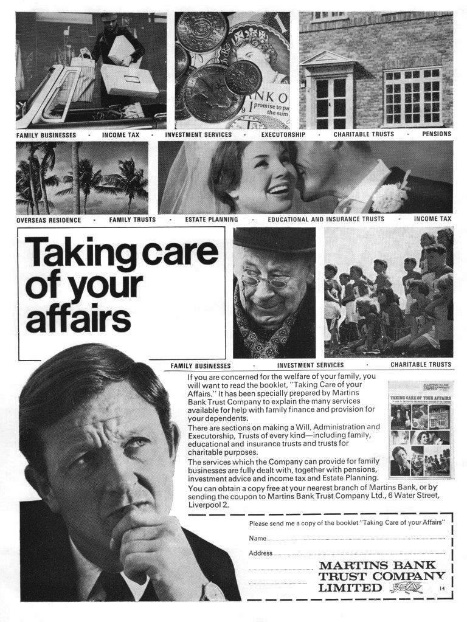
 Formed from the existing
trustee and investment business of Martins Bank, which dated back to 1908
when the Bank of Liverpool first opened a trustee department, Martins
Bank Trust Company Limited brought together a number of servies which had
been key earners for the bank in the various parts of the country where
there was either a Trustee Office, an Income Tax Department, or both. Formed from the existing
trustee and investment business of Martins Bank, which dated back to 1908
when the Bank of Liverpool first opened a trustee department, Martins
Bank Trust Company Limited brought together a number of servies which had
been key earners for the bank in the various parts of the country where
there was either a Trustee Office, an Income Tax Department, or both.
By the late 1960s,
notwithstanding the search for another bank with with to merge, Martins
Bank aquired a number of smaller specialist companies as subsidiaries,
each of which specialised in financial services, that would enable the
Bank to spread its interests, provide a more comprehensive offering to
the customer AND
that
would profit the Bank, by retaining those customers might have gone
elsewhere for these services.
Thanks to the Denis
Maxwell Collection, our Archive now has insight into these companies, as
well as the merger processes that began as early as 1961 and continued on
and off until the merger with Barclays.
When you visit our TRUSTEE AND INVESTMENT SERVICES feature page, you will
now find more detailed information than we have previously offered for
the following:
·
Dillon Walker
& Co
·
Griffin Assurance
·
Martins
Unicorn
·
Martins Bank (Finance)
Limited
|
|